



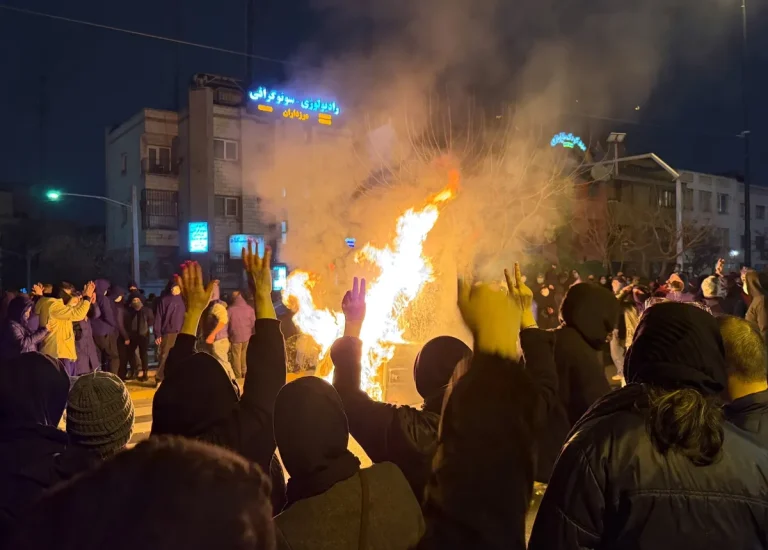
(Bloomberg) The number of people reported killed in Iran’s protest crackdown has surged as rights groups continue to verify suspected fatalities, with one United Nations special rapporteur saying the total could be more than 20,000.
The US-based Human Rights Activist News Agency said it’s verified 5,002 deaths during the unrest that erupted in late December. The group is reviewing a further 9,787, while more than 26,000 people have been arrested, it said.
Mai Sato, the UN’s special rapporteur on the situation of human rights in the Islamic Republic of Iran, told ABC earlier this week that the number of civilians killed is estimated at 5,000 or more. Reports from doctors in the country suggest the figure may be at least 20,000, she said, later adding that the figure hasn’t been verified by the UN.
Rights groups attempting to measure the true toll of Iran’s suppression of some of the biggest demonstrations since the 1979 revolution have been hampered by ongoing restrictions to internet access and telecommunications. The protests were triggered in Tehran by a collapse in the currency, before spreading nationwide with calls for the end of Supreme Leader Ayatollah Ali Khamenei’s regime.
Amnesty International said Friday that Iranian authorities committed “mass unlawful killings on an unprecedented scale” from Jan. 8-9 and had imposed a system of “suffocating militarization” on the population to crush dissent and prevent access to the outside world. The UN Human Rights Council in Geneva is scheduled to hold a special session on Iran at 2 p.m., local time.
Iranian authorities provided their own toll for the first time on Wednesday, reporting 3,117 deaths, of which 2,427 are considered “innocent” — including members of the security forces, according to a statement by Iran’s National Security Council. It didn’t provide a breakdown or refer to any civilians.
An international fact-finding mission launched in the wake of Iran’s 2022 anti-government protests should include potential crimes against humanity by the Iranian state in the latest uprising, Sato said.
US President Donald Trump at one point suggested he would intervene in the Iranian protests before backing off. Speaking to reporters on Thursday, he dangled the threat again, saying the country has a “massive fleet” going toward Iran, referring to a buildup of US naval forces in the Middle East.
“I’d rather not see anything happen, but we’re watching them very closely,” he said.
(The New York Times) President Trump sharply intensified his threats against Iran on Wednesday, suggesting that if it did not agree to a set of demands the administration had made of the country’s leaders, he could soon mount an attack “with speed and violence.”
Mr. Trump’s threat of a second direct attack on Iran by U.S. forces in eight months came as the aircraft carrier Abraham Lincoln, along with other naval ships, bombers and fighter jets, took up positions in the region in striking distance of the country. Mr. Trump explicitly compared the buildup to the forces he amassed near Venezuela late last year, just ahead of the operation that seized Nicolás Maduro and his wife in the middle of the night early in January.
Mr. Trump gave no specifics about the deal he was demanding, saying only that a “massive Armada” was heading toward Iran and that the country should make a deal. But U.S. and European officials say that in talks, they have put three demands in front of the Iranians: a permanent end to all enrichment of uranium, limits on the range and number of their ballistic missiles, and an end to all support for proxy groups in the Middle East, including Hamas, Hezbollah and the Houthis operating in Yemen.
Notably absent from those demands — and from Mr. Trump’s post on Truth Social on Wednesday morning — was any reference to protecting the protesters who took to the streets in Iran in December, convulsing the country and creating the latest crisis for its government. Mr. Trump had promised, in past social media posts, to come to their aid, but has barely mentioned them in recent weeks.
Iran says the death toll was 3,117, but human rights groups say that figure vastly underestimates the actual number killed. Their figures range from 3,400 to 6,200, but given the scope of internet blackouts and government efforts to quickly bury bodies, the true toll may never be known.
Mr. Trump has felt emboldened since the initial success in Venezuela, and he was clearly using the threat of a similar decapitation of the Iranian regime in an effort to intimidate the country’s clerical leadership and the Islamic Revolutionary Guard Corps, its most elite military forces.
As recently as two weeks ago, Mr. Trump appeared to be on the precipice of military action, which he suspended only when receiving an assurance from Iran that it would not hang what he said were 800 protesters set to be executed. Iranian officials said that figure was wrong, and that the protesters, while arrested, had not gone through trial or sentencing.
The interchanges that day revealed to the Americans the fragility of the Iranian system. The country’s foreign minister, Abbas Araghchi, a longtime Iranian diplomat and politician, had to seek permission to talk with Steve Witkoff, Mr. Trump’s special envoy. In the end, he had to make the commitment through a third party that Iran was not planning imminent executions, because he was prohibited from formal, direct communications with the United States.
An official who was deeply involved in the interchanges said later that Mr. Araghchi’s authority seemed heavily constrained. And there is, as always in the Iranian system, constant jockeying between the Supreme Leader’s office, the Revolutionary Guard and the office of the president, Masoud Pezeshkian, for whom Mr. Araghchi works. But key issues of foreign policy are decided by the 86-year-old supreme leader, Ayatollah Ali Khamenei.
On Wednesday, speaking to Iranian reporters outside the foreign ministry in Tehran, Mr. Araghchi said that Iran had not requested a meeting with the United States and that he and Mr. Witkoff had not been in contact in recent days. He said Iran had not made a decision about negotiations, although various countries were trying in good faith to mediate between Tehran and Washington.
“Our position is that diplomacy cannot be effective and have results through military threats,” he said. “If they want negotiations to take place, they definitely have to set aside threats, excessive demands and making unrealistic demands,” Mr. Araghchi added. A war between Iran and the United States, he said, would be destabilizing to the entire region, and countries in the Middle East were against it.
Mr. Araghchi issued a warning to the United States a week ago, writing that “an all-out confrontation will certainly be messy, ferocious and drag on far, far longer than the fantasy timelines that Israel and its proxies are trying to peddle to the White House.” He added that “the U.S. has tried every conceivable hostile act, from sanctions and cyber assaults to outright military attacks.”
“It is time to think differently,” he concluded. “Try respect.”
On Wednesday, Secretary of State Marco Rubio told lawmakers that the buildup around Iran was largely defensive, because tens of thousands of American troops in the region were “within the reach of Iranian one-way drones and ballistic missiles.” He said it was “wise and prudent” to increase the U.S. presence, but that the American force could also “preemptively act” against Iran.
“I hope it doesn’t come to that,” he said.
In the past week, negotiations have made no progress, officials say, and there are no indications that the Iranians are preparing to give in to Mr. Trump’s demands. Each would undercut the country’s diminishing powers after a 12-day war with Israel in June, which ended with a U.S. air attack on three major Iranian nuclear sites, at Natanz, Fordo and Isfahan.
The three sites were central to the enormous nuclear infrastructure Iran had built over more than a quarter of a century. While Mr. Trump has repeatedly claimed the nuclear program was “obliterated,” his own national security strategy, published in the fall, took a more measured view, saying that the attack in June “significantly degraded Iran’s nuclear program.”
The first demand, that Iran give up all nuclear enrichment, would be difficult to monitor. The primary enrichment sites at Natanz and Fordo were heavily hit, and are unlikely to reopen. But it is possible to enrich uranium — increasing its purity — at small, easily hidden sites. If Iran could gain access to the uranium already enriched to 60 percent purity — just shy of bomb grade — that was buried in the attacks, it could make enough fuel for a handful of weapons. So far, according to U.S. and European intelligence officials, there is no sign that Iran has gotten that access to the fuel, which it had buried deeply for safekeeping.
The second demand, to limit the range and number of ballistic missiles, would make it all but impossible for Iran to hit Israeli territory. Those missiles are the last deterrent in Iran’s arsenal against a renewed attack by Israel. Such an attack does not seem imminent, but Prime Minister Benjamin Netanyahu has threatened renewed attacks if Iran re-arms.
The third demand, involving cutting off support for proxy forces, may be the easiest for Iran to comply with. Iran’s own economy is deeply weakened, its currency has fallen to new lows, and the government has little to spend on its one-time allies, who are reeling from intense attacks by Israel.